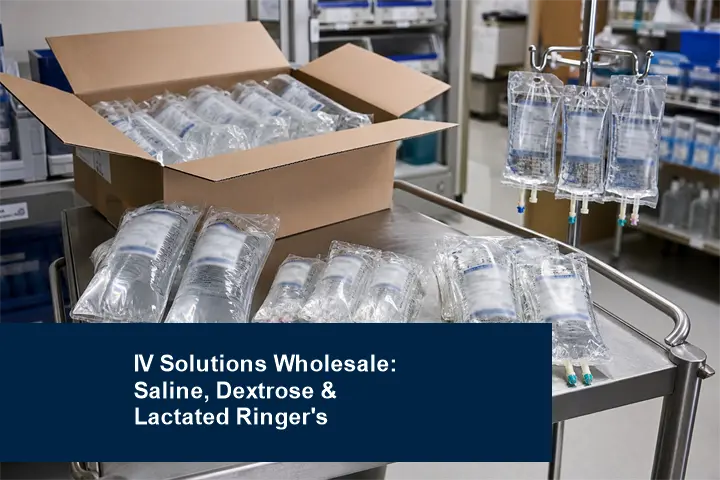
IV solutions are the highest-volume sterile product most facilities buy, and four families cover the large majority of demand: sodium chloride (saline), dextrose, lactated Ringers, and sterile water. They are supplied in flexible bags from 50 mL minibags through 1,000 mL, ordered by the case. The 2024-2025 national shortage reset how procurement teams think about this category. After Hurricane Helene flooded the plant that supplied roughly 60% of the U.S. IV fluid supply, facilities spent months on allocation. FDA removed 0.9% sodium chloride injection from its shortage list in August 2025. The lesson buyers carried forward is that a single-source IV fluid strategy is a risk position, not a savings position.
For a hospital, surgery center, or urgent care clinic, IV solutions are a recurring, high-frequency purchase with almost no clinical substitutability at the moment of use. When a 1,000 mL bag of 0.9% sodium chloride is not on the shelf, the case does not proceed. That combination of high volume and low substitutability is what makes IV fluid procurement a different exercise from most med-surg categories, and it runs through the whole infusion chain from the bag to the Administration Set to the peripheral catheter. This guide covers the solution families, the bag sizes that shape an order profile, and how facilities build a fluid formulary that holds up when supply tightens. Clinical selection for any individual patient stays where it belongs: with the care team.
What Are IV Solutions?
IV solutions are sterile fluids packaged in flexible bags for intravenous administration, used for hydration, electrolyte replacement, as a vehicle for drug delivery, and for line maintenance. From a buyer's standpoint, three attributes define any given SKU: the solution family, the fill volume, and the bag material and port configuration.
Bag material has become a procurement variable in its own right. Traditional flexible IV bags are PVC plasticized with DEHP, and a California statute now sets a phase-out clock on that construction. We cover the compliance detail and the EVA alternatives in our guide to sourcing non-DEHP and non-PVC IV bags.
The Four Solution Families a Facility Stocks
Nearly all IV solution volume in a general facility falls into four families. The table below pairs each with the concentrations and bag sizes buyers actually see on a purchase order.
| Family | Common Concentrations | Typical Fill Volumes | Primary Buyer Role | Stocking Notes |
|---|---|---|---|---|
| Sodium chloride (saline) | 0.9%, 0.45%, 3% | 50, 100, 150, 250, 500, 1,000 mL | Hydration, drug diluent, line flush and maintenance | Highest-turn family; 0.9% in 1,000 mL and minibags dominate |
| Dextrose | D5W, D10W, D50, D5/0.45% NaCl | 50, 250, 500, 1,000 mL | Caloric support, drug diluent, hypoglycemia protocols | D5W is the workhorse; combination solutions add SKU count |
| Lactated Ringers | Standard LR, LR with dextrose | 250, 500, 1,000 mL | Volume resuscitation, perioperative fluid | Heavier weighting in surgical and emergency settings |
| Sterile water | Sterile water for injection | 50 to 1,000 mL | Reconstitution and dilution | Lower volume; stocked in defined quantities |
Multi-electrolyte solutions such as Isolyte sit alongside these four in facilities with specific perioperative or critical care protocols, and are stocked in smaller defined quantities.
Why Fill Volume Drives the Order Profile More Than Family
Buyers new to this category tend to think in terms of solution families. Experienced materials managers think in terms of fill volumes, because that is where the storage math and the allocation risk concentrate.
A 1,000 mL bag occupies far more shelf space per unit than a 100 mL minibag and moves at a completely different velocity, and the case counts reflect it: 1,000 mL ships 10 to 14 per case while 100 mL ships 64 to 96. During the 2024 allocation period, 1,000 mL saline was the constrained item at most facilities while minibags remained comparatively available, because pharmacy compounding, drug delivery, and line maintenance consume small volumes at high frequency while resuscitation and perioperative hydration consume large volumes in bursts. A facility that models par levels by family rather than by fill volume will get the storage plan and the reorder point wrong on both ends.
What the 2024-2025 Shortage Changed for Buyers
On September 26, 2024, Hurricane Helene made landfall and flooded Baxter's North Cove manufacturing site in western North Carolina. Roughly 60% of the national IV fluid supply came from that one plant. Within weeks, hospitals across the country were postponing elective procedures, rationing 1,000 mL saline bags, and substituting oral hydration where clinically acceptable.
The federal response was unusually fast. The Biden administration invoked the Defense Production Act to accelerate the plant's recovery, FDA authorized extended use dates on certain products and cleared temporary imports from Europe and Asia, and Baxter had eight of ten manufacturing lines restarted by mid-December 2024. FDA removed 0.9% sodium chloride injection from its shortage list in August 2025, formally closing the event.
What did not reset is the procurement posture. A Boise State College of Business analysis found that 20% of U.S. hospitals shifted toward broader local and diversified sourcing during 2024. For IV fluids specifically, the practical change was that buyers who had a qualified secondary or contingency vendor relationship in place before the storm moved through the allocation period with materially less disruption than buyers who started making calls in October. Building that relationship is cheap when you do not need it and impossible to build quickly when you do.
Building an IV Fluid Formulary That Holds Under Allocation
The formulary question for IV solutions is narrower than for most categories, because the clinical set is small and standardized. The procurement work is in three areas.
- Concentration discipline. Facilities accumulate combination solutions (D5 with varying saline concentrations, LR with dextrose) that duplicate each other across departments. Auditing usage by SKU over 6 to 12 months usually reveals several low-turn concentrations that can be consolidated without clinical objection.
- Fill-volume par levels set separately. Model minibags and large-volume bags as distinct inventory problems with their own reorder points, because their demand curves and storage footprints do not correlate.
- A qualified contingency vendor, documented before you need it. This is the direct lesson of 2024. The account should exist, the SKUs should be cross-referenced, and pricing should be on file.
That third point is where most facilities were unprepared. If you want a cross-reference built against your current fluid formulary so a second source is ready rather than theoretical, our team can put that together with case-quantity pricing.
How to Buy IV Solutions in Bulk
IV solutions ship by the case, and case count tracks fill volume closely. Across the references we stock, 1,000 mL bags run 10 to 14 per case, 250 mL and 500 mL bags run 20 to 36 per case, and 50 mL and 100 mL minibags run 64 to 96 per case. Case quantity ordering is the default for the high-turn references because the cost per bag drops meaningfully and because fluid has a long enough dating window that reasonable overstock does not create waste risk the way low-turn specialty items do.
Storage capacity is the practical ceiling. Fluid is bulky and heavy, and a facility with limited clean storage cannot simply order a quarter ahead. That constraint argues for a distributor who can support a more frequent delivery cadence without penalizing smaller orders.
Driven by an obsession with customer experience, MAP Medical works as a single-source wholesale partner for clinics, surgery centers, hospitals, and multi-site networks across the U.S., Canada, and EMEA, supplying Baxter, B Braun, ICU Medical, and Grifols IV solutions across the fill volumes facilities actually run. Buyers come to us when a primary vendor falls short and stay because we work like an extension of their own purchasing team.
Frequently Asked Questions
Is the IV fluid shortage over?
Yes. FDA removed 0.9% sodium chloride injection products from its shortage list in August 2025, closing the event that began when Hurricane Helene flooded Baxter's North Cove plant in September 2024. Many procurement teams have kept the dual-sourcing practices they adopted during the allocation period.
What IV solutions does a facility need to stock?
Four families cover most demand: sodium chloride (0.9% is the highest-turn reference), dextrose (D5W and combination solutions), lactated Ringers, and sterile water for injection. Facilities with specific perioperative or critical care protocols also stock multi-electrolyte solutions such as Isolyte in smaller quantities.
What bag sizes do IV solutions come in?
Flexible IV bags run from 50 mL minibags through 1,000 mL large-volume bags, with 100, 150, 250, and 500 mL in between. Minibags serve drug delivery and line maintenance at high frequency, while 1,000 mL bags serve hydration and resuscitation. The two groups have different demand curves and should be modeled with separate par levels.
How many IV bags come in a case?
Case counts track fill volume. Across the references we carry, 1,000 mL bags run 10 to 14 per case, 250 mL and 500 mL bags run 20 to 36 per case, and 50 mL and 100 mL minibags run 64 to 96 per case, varying by manufacturer and container. Case quantity ordering lowers cost per bag on high-turn references.
What is the difference between normal saline and lactated Ringers for purchasing?
From a stocking standpoint, 0.9% sodium chloride is the broader-use reference, consumed across hydration, drug dilution, and line maintenance in every department. Lactated Ringers is weighted more heavily toward surgical, perioperative, and emergency volume. A facility's LR-to-saline ratio is a direct reflection of its case mix.
Should a facility have a contingency vendor for IV fluids?
The 2024-2025 shortage made a strong case for it. Facilities that had a qualified contingency vendor and a cross-referenced SKU list before the disruption moved through allocation with less impact than those that began sourcing after the fact. A contingency vendor costs nothing to hold and cannot be established quickly under pressure.
Do IV bags contain DEHP?
Many traditional flexible IV bags are PVC plasticized with DEHP. California's Toxic-Free Medical Devices Act (AB 2300) prohibits intentionally added DEHP in IV solution containers sold or distributed in California starting January 1, 2030, and in IV tubing starting January 1, 2035. Non-PVC and EVA alternatives are already available across most fill volumes.
How long can IV fluids be stored before use?
Dating varies by product and manufacturer, and labeled expiration should always govern. During the 2024 shortage FDA authorized extended use dates on certain Baxter products, which is a reminder that dating is a regulatory decision rather than a fixed property. For normal purchasing, fluid dating is long enough that case-quantity ordering on high-turn references does not create meaningful expiration risk.
What This Means for Procurement Teams
IV solutions are a small clinical set and a large logistical problem. Model par levels by fill volume rather than by solution family, consolidate the low-turn combination concentrations that accumulate across departments, and hold a qualified second source that is documented before you need it. MAP Medical is a wholesale medical supply distributor built around three things facility buyers tell us they need most: responsive service, fast turnaround, and single-source ordering across thousands of critical med-surg supplies. We carry the solution families above at wholesale pricing, with a team that responds the same day when a buyer needs an answer. If you are qualifying a contingency vendor or rebuilding your fluid par levels, we are happy to build the cross-reference against your current formulary.
Our IV Solutions Catalog
The references below cover sodium chloride, dextrose, lactated Ringers, and multi-electrolyte solutions from Baxter, B Braun, ICU Medical, and Grifols, prioritized by buyer demand. You can find the selected products in the table below.
| Product / SKU | Sales Description |
|---|---|
| Baxter 2B1308 | Sodium Chloride Injection Solution, USP, 0.9%, 50 mL, VIAFLEX Flexible Plastic Container, 96 |
| ICU Medical 07926-03 | Injectable Solution 5% Dextrose/0.45% Sodium Chloride 500mL Bag 24/Ca |
| B Braun L5102 | Dextrose / Water, Preservative Free 5% IV Solution 250ml, 24 Per/Cs |
| B Braun L7500 | Lactated Ringers Solution Lactated Ringer's Bag 12/Ca |
| B Braun L5101 | Dextrose / Water, Preservative Free 5% IV Solution 500ml, 24 Per/Cs |
| Baxter 2B0042 | 0.9% Sodium Chloride Injection, USP, 50 mL MINI-BAG Plus Container. Quad Pack, 80/CS |
| B Braun Q8000 | Sodium Chloride 0.9% IV Solution 1,000 mL, 12 Per/Cs |
| Baxter 2B1307 | Baxter 0.9% Sodium Chloride Injection, USP, 100 mL VIAFLEX Plastic Container, Single pack, 9 |
| B Braun L7501 | Lactated Ringer's Solution IV Solution 500 mL, 24 Per/Cs |
| Grifols 729620 | Sodium Chloride 0.9% IV Inj Sol Grifols,S.A 500mL Non-DEHP 20/Ca |
| B Braun L8002 | Solution Sod Cl.9% 250mL Non-DEHP/Non-PVC 250mL/Bg, 24 EA/CA |
| Baxter 2B0043 | DBD-SOLUTION, SODIUM CHLORIDE 0.9%, 100ML, 80 PER/CS |
| B Braun L5100 | Dextrose / Water, Preservative Free 5% IV Solution 1,000ml, 12 Per/Cs |
| Baxter 2B1073Q | IV Injection Solution Dextrose 5%/Sodium Chloride 0.45% 500mL Vflx Cntnr EA, 24 EA/CA |
| B Braun Q8001 | Sodium Chloride 0.9% IV Solution 500 mL, 24 Per/Cs |
| B Braun L7070 | SOLUTION, ISOLYTE S, PH 7.4, 1000ML, 12/CS |
| Baxter 2B1064X | Viaflex IV Injection Solution Dex5/Sod Cl.9 1000 Plstc Cntnr Ea, 14 EA/CA |
| Grifols 731359 | IV Injection Solution Sodium Chloride 0.9% 250mL, 28 Per/Cs |
| Baxter 2B1324X | Sodium Chloride Injection Solution, USP, 0.9%, 1,000ml, VIAFLEX Flexible Plastic Container 1 |
| Baxter 2B1313Q | Sodium Chloride 0.45% IV Solution Viaflex 500mL Ea, 24 BG/CA |
| Baxter 2B0041 | Dextrose Injection, 5% USP, 100 ml, Mini-Bag Plus Container, Quad Pack, 80/cs |
| Baxter 2B1302 | Sodium Chloride: 0.9% Sodium Chloride (NaCl) Injection Solution, USP, 100-mL VIAFLEX Plastic |
| B Braun L5200 | Injection Solution Dextrose 10%/Water 1000mL Excel IV Container 12/Ca |
| Baxter 2B1074X | Dextrose Solutions: Solution 5% Dextrose/0.45% Sodium Chloride, 1000 mL, 14 Per/Cs |
| ICU Medical 07929-03 | Lactated Ringers Solution Dextrose 5% 500mL Bag Ea, 24 EA/CA |
| Baxter 2B1306 | Injection, Sodium Chloride: 0.9% Sodium Chloride (NaCl) Injection Solution, USP, 50-mL VIAFL |
| B Braun L6121 | IV Injection Solution Dextrose 5%/Sodium Chloride 0.45% 500mL Plstc Cntnr Ea, 24 EA/CA |
| B Braun L7071 | IV Solution Isolyte S pH 500mL Bag 24/Ca |
| B Braun S8004-5384 | Sodium Chloride 0.9% Injection Solution 50mL Non-DEHP/Non-PVC for Safe and Effective IV Ther |
| B Braun S8004-5264 | Sodium Chloride, Preservative Free 0.9% IV Solution 100mL Fill in 150ml, 64 Per/Cs |
| Baxter 2B2073Q | Caloric Agent Dextrose / Lactated Ringer's Solution 5% IV Solution Flexible Bag 500 mL 24/CS |
| Baxter 2B1322Q | Solution 0.9% Sodium Chloride 250mL 250ml/Bg, 36 EA/CA |
| Baxter 2B2322Q | Lactated Ringer's Solution IV Solution 250ml, 36 Per/Cs |
| B Braun L6100 | Dextrose / Sodium Chloride 5% - 0.9% IV Solution 1,000ml, 12 Per/Cs |
| Baxter 2B0063Q | 5% Dextrose Solution, USP, 500 mL, Bag 24/ case |
| Baxter 2B2074X | Viaflex IV Injection Solution Dextrose 5%/Lactated Ringers 1000mL Plstc Cntn (14/CS) |
| B Braun L5201 | Dextrose / Water, Preservative Free 10% IV Solution 500ml, 24 Per/Cs |
| Baxter 2B2323Q | Lactated Ringer's Solution IV Solution 500ml, 24 Per/Cs |
| B Braun L6120 | Dextrose / Sodium Chloride 5% - 0.45% IV Solution 1,000ml, 12 Per/Cs |
| Baxter 2B1301 | Sodium Chloride: 0.9% Sodium Chloride (NaCl) Injection Solution, USP, 50-mL VIAFLEX Plastic |
| Grifols 731360 | IV Injection Solution Sodium Chloride 0.9% 1000mL, 10 Per/Cs |
| B Braun L5202 | Dextrose / Water, Preservative Free 10% IV Solution 250ml, 24 Per/Cs |
| B Braun L7510 | 5% Dextrose in Lactated Ringer's Injection, 1000 mL, 12/CS |
| Baxter 2B0062Q | 5% Dextrose Solution, USP, 250 mL, Bag 36/ case |
| B Braun S5104-5384 | 5% Dextrose Injection USP, 50 Fill in 100 mL PAB, 84 UNITS/CS |
| Baxter 2B2324X | SOLUTION, RINGER'S, LACTD, INJECTION, 1000ML, 14 PER/CS |
| Baxter 2B1323Q | SOLUTION, NACL, INJ, 0.9%, 500ML, BAG, 24 PER/CS |
| Baxter 2B2543Q | SOLUTION, PLASMA-LYTE A INJECT PH 7.4, 500, 24 BG/CS |
| B Braun L7511 | Dextrose / Lactated Ringer's Solution 5% IV Solution 500ml, 24 Per/Cs |
| Baxter 2B1314X | Sodium Chloride 0.45% IV Solution Viaflex 1000ml, 14 EA/CA |
| Baxter 2B1309 | IV Injection Solution Sodium Chloride 0.9% 100mL Viaflex Plastic Container 96 Per/Cs |
| B Braun L8501-01 | IV SOLUTION, H2O, STERILE, 500ML, 24/CS |
| B Braun S5104-5264 | DEXTROSE, IVSOL 5% 100ML/150ML FILLPAB (64/CS) |
| B Braun L7502 | Lactated Ringer's Solution IV Solution 250ml, 24 Per/Cs |
Get wholesale pricing on IV solutions - with the service and speed your facility deserves. Contact MAP Medical to optimize your formulary today.
Buying IV Solutions Wholesale: Saline, Dextrose, and Lactated Ringers by the Case